
Bench Warrants in McLeod County
A bench warrant is just the everyday label for a judge's order against someone who skips an obligation in a case already open. Missed court dates trigger most of them. An unpaid fine can do it too, and so can an unmet condition or a probation term that lapsed. McLeod County's public warrant table has no bench-warrant column of its own. The reason hides in the Description field instead, where phrases like failure to appear, probation violation, contempt, and failure to compliance tell you which kind you are looking at. Family and child-support enforcement runs on a separate court line. Those matters may never show up in the criminal table at all.
McLeod Bench Warrants Live in a Unified District Court
Minnesota keeps its trial courts unified rather than scattering them across justice-of-the-peace precincts. McLeod County sits in the First Judicial District, and the McLeod County District Court holds original jurisdiction over every criminal and traffic matter filed here. Almost any bench warrant a McLeod County resident runs into comes from that one court. City processes do exist, but they cover little ground. Glencoe runs a municipal court for city matters, and Winsted publishes a citation payment route. When the venue is unclear, ask the issuing city first, then confirm with Court Administration before assuming where the case lives.
How a McLeod County Bench Warrant Is Issued
The judge signs the order from the bench or on the papers once the missed obligation is established. Under Minnesota Rule of Criminal Procedure 3.02, the warrant needs a judge's signature, an identified defendant, and the charged offense, with bail or conditions set by the court. A bench warrant in McLeod County carries the full authority of the underlying case. Once issued, the event lands in the District Court case system. It may surface in law-enforcement systems or on the sheriff's public table, depending on access rules. The warrant stays open until the person appears, the court recalls it, or it is served.
McLeod County FTA Warrants vs Sign-and-Release
Minnesota gives qualifying defendants a warrant that does not authorize arrest. Minn. Stat. 629.415 creates that option, covering a failure to appear in a misdemeanor or gross misdemeanor case after a summons was served and returned.
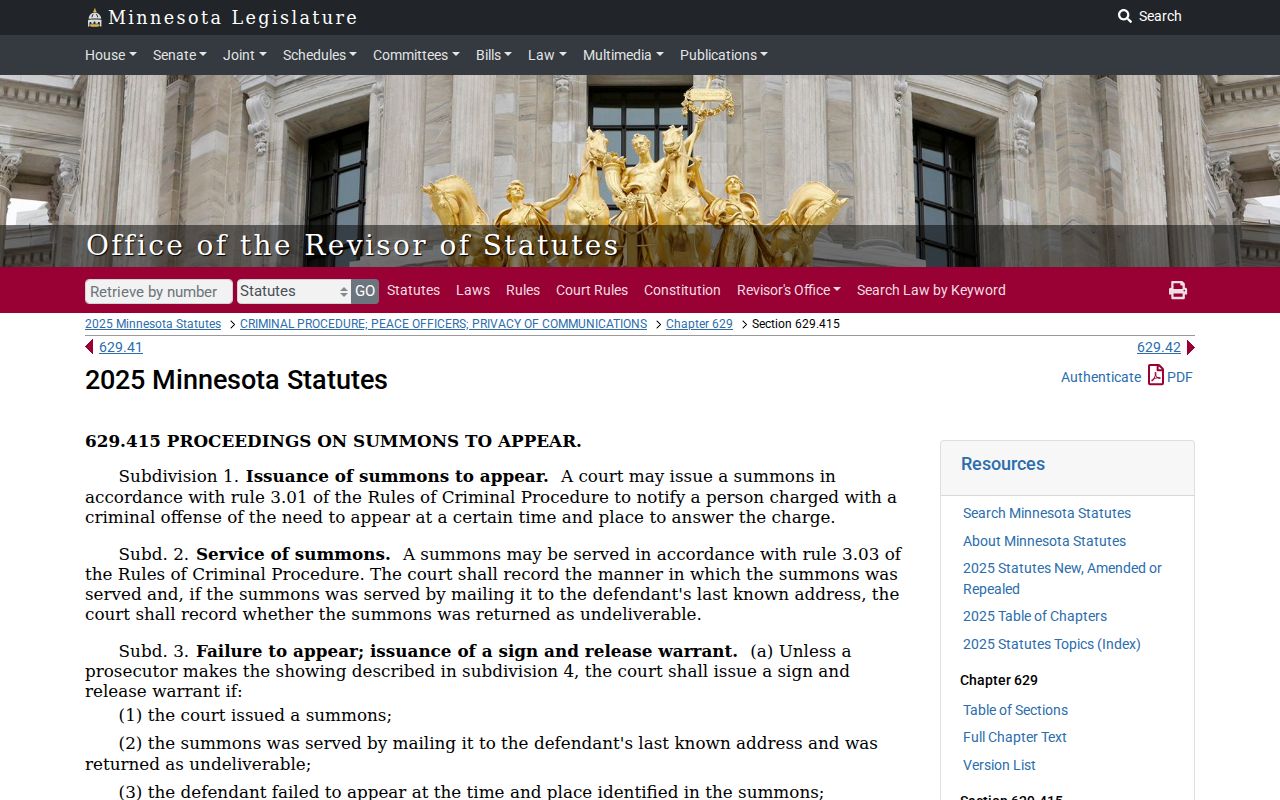
Under that process, the officer hands over written notice of a new court date, releases the person at the scene, and inactivates the warrant. The statute is narrower than a McLeod County bench warrant in the plain sense, so ask the court directly whether it fits your case.
Bench Warrant vs Arrest Warrant
On paper the two orders look alike, and in practice they act differently. One enforces an obligation in a case that already exists, while the other answers a new allegation. For the probable-cause path, see arrest warrants.
| Feature | Bench Warrant | Arrest Warrant |
|---|---|---|
| Trigger | Missed date, payment, or condition | Alleged offense |
| Who issues it | The judge on the existing case | A judge on a complaint or affidavit |
| Underlying case | Already open when the warrant issues | New or newly charged conduct |
| How it clears | Appear, reset, pay, or recall | Appearance, bond, or surrender |
The sign-and-release statute adds a third shape in McLeod County, one that applies only to qualifying failures to appear.
Probation, Contempt, and FTA on McLeod County Warrants
Four words in the McLeod County sheriff's Description column lead down four different paths. Sort them out early, and you avoid a wasted call and an unnecessary payment.
- Failure to appear (FTA)
- A missed court date or other required appearance.
- Probation violation
- An alleged breach of a probation condition, handled by the criminal court.
- Contempt
- Alleged disobedience of a court order, which a fine payment will not resolve.
- Complaint warrant
- A warrant tied to a filed criminal complaint, not a missed date.
How to Resolve a McLeod County Bench Warrant
In McLeod County, the order of operations matters more than speed. Confirm the warrant, learn whether it authorizes arrest, and only then pick a route into court.
- Call dispatch at 320-864-3134 and confirm the warrant, then identify the court that issued it.
- Call the criminal line (A-L 320-864-1282, M-Z 320-864-1283) and ask whether the case qualifies for sign-and-release.
- Talk with a licensed Minnesota attorney about a reset, a recall motion, or an appearance arranged through counsel.
- Clear the underlying obligation, whether that means a new date, a payment, or a hearing on the missed condition.
Caution: a bench warrant does not expire on its own. It can surface at a traffic stop, and an unresolved citation can also interrupt licensing or registration business.
The McLeod County Warrant Turn-In Cutoff
The McLeod County jail accepts a voluntary turn-in at any hour, with one practical condition attached. Want a shot at that day's court calendar? Arrive before 9:00 a.m. on a weekday, excluding holidays. The jail states plainly that same-day placement is not guaranteed. An arrival after the cutoff still gets processed, but the court date usually lands on the next scheduled court day. Booking, paperwork delivered to Court Administration, and release processing can stretch for hours after the jail receives court information. Plan on a full day in McLeod County, and confirm the route with dispatch before you go.
Which McLeod County Court Issued the Warrant
A bench warrant belongs to the court that set the underlying case, and only that court controls the recall. The sheriff in McLeod County serves and tracks warrants but cannot shorten or dismiss one. So identify the court before anything else. A criminal matter sits with District Court and its criminal line. A citation belongs to the traffic division or the issuing city, while a family or child-support matter uses the family line. Run a warrant search to trace where the case is docketed, and call Court Administration if the answer is still unclear.
McLeod County Warrant Phone Routing by Surname
McLeod County Court Administration answers criminal and traffic calls by surname. The split saves you a transfer. For criminal matters, dial 320-864-1282 if your last name starts with A through L. Dial 320-864-1283 for M through Z. Traffic uses the same letter split: 320-864-1760 covers A-L, and 320-864-1761 covers M-Z. Fines on a traffic warrant go through the Minnesota Court Payment Center at 651-281-3219 or 800-657-3611. The main court line is 320-864-1281, Court Administrator Karen Messner sits at 320-864-1285, and it never hurts to confirm the split when you call, since assignments change.